


Declining a dish shouldn't cost you the evening.
The fear of "being perceived as difficult and unappreciative when declining offered but potentially unsafe food" is a defined clinical construct, not a personality trait.
Engel, Herbert, Ramos, Gupta & Warren, Pediatric Allergy and Immunology, 2025.
We reviewed 13 food, list and event apps in 2026. None of them protected a guest's dietary detail from the host by default — the social ones are built on the opposite.
Picky Eaters competitor review, 13 App Store listings and their user reviews.
The apps built around ARFID and selective eating are few and small, and most of them are made for children and their parents.

Why this exists
Picky Eaters exists because at a shared table the cost of speaking up falls on the person with the least room to negotiate. Everything in the product follows from one decision: move that conversation out of the moment of the meal and into something you set up once, in private.
How it works
- Step 1
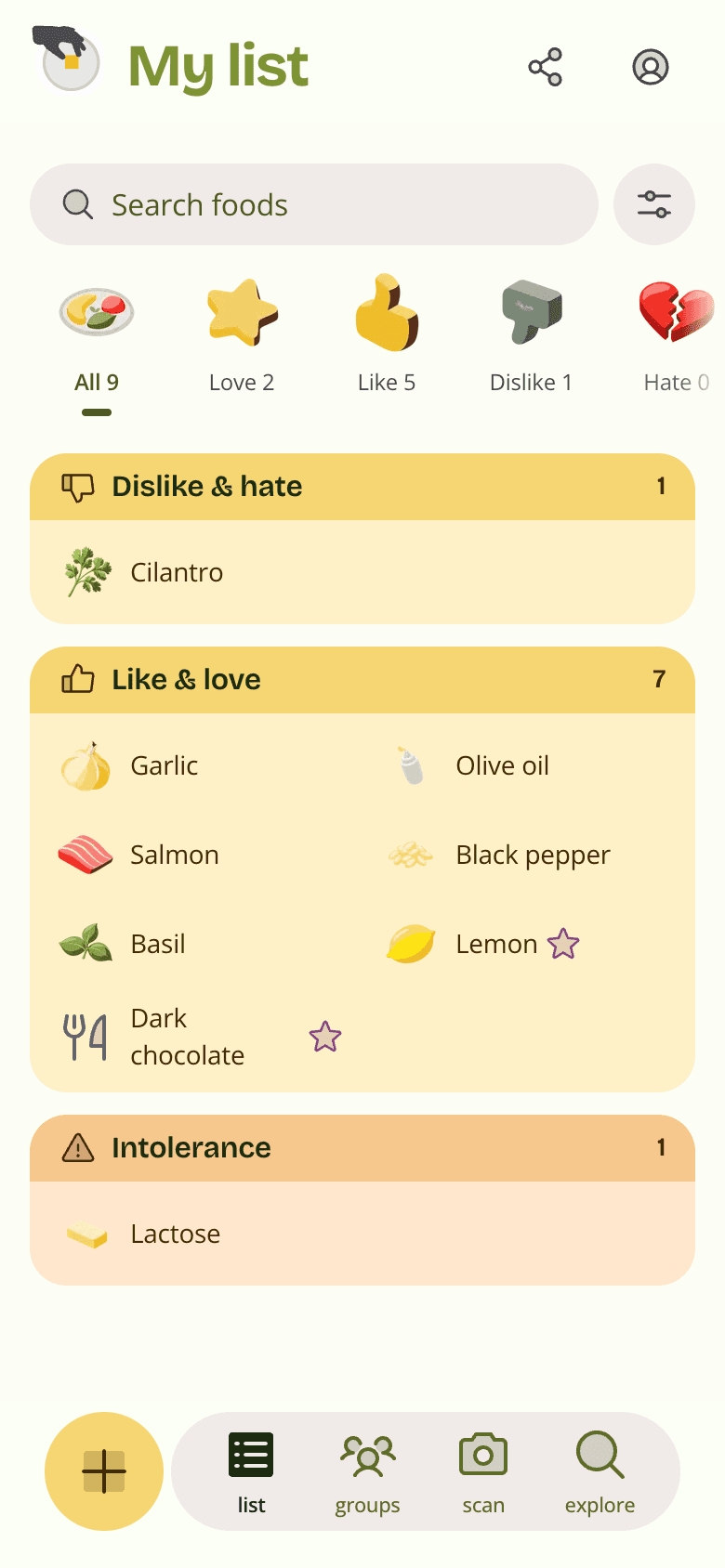
Add a food and say how you feel about it, or flag it as an allergy, an intolerance or ARFID. The list is yours and stays private.
- Step 2
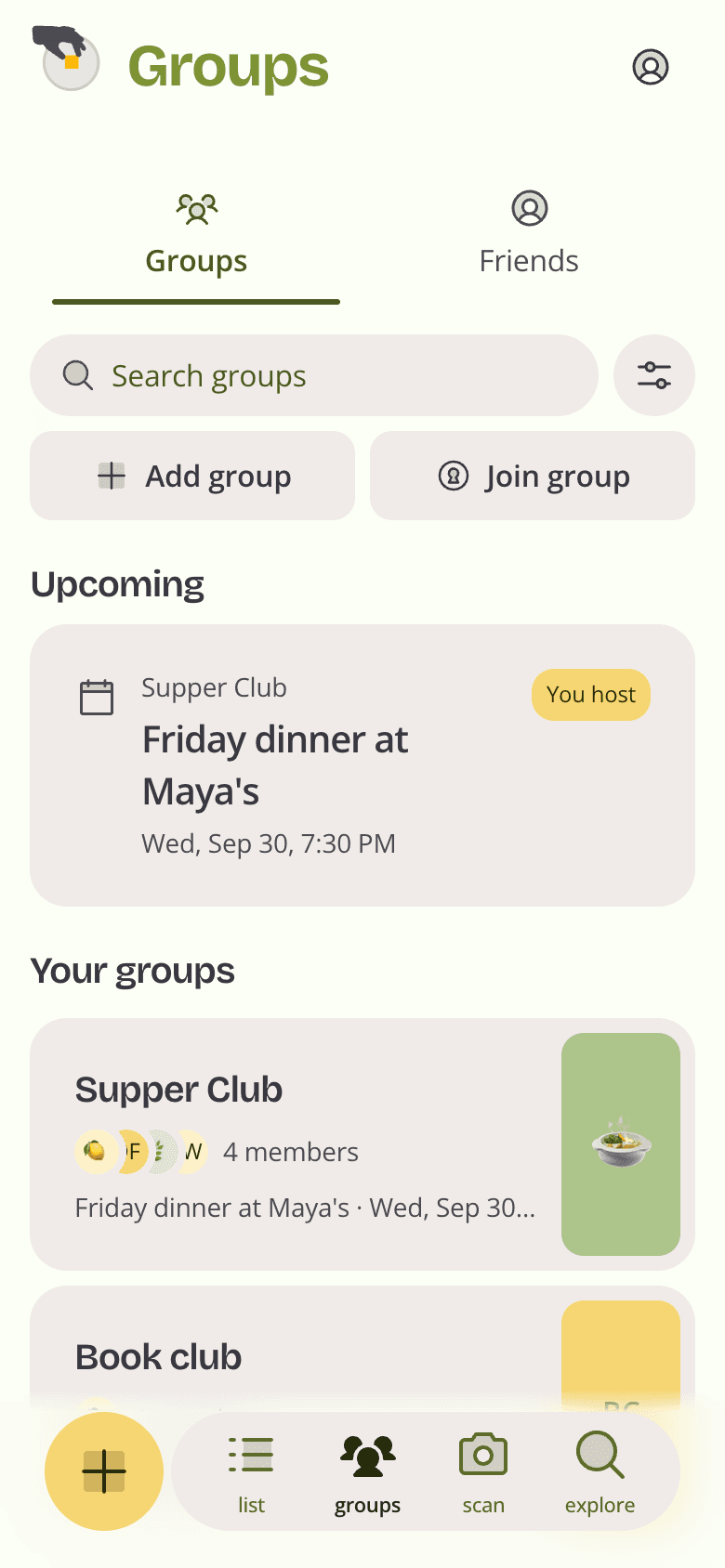
A host sends a link. Accepting applies your list to that meal, so you never have to explain yourself at the table.
- Step 3
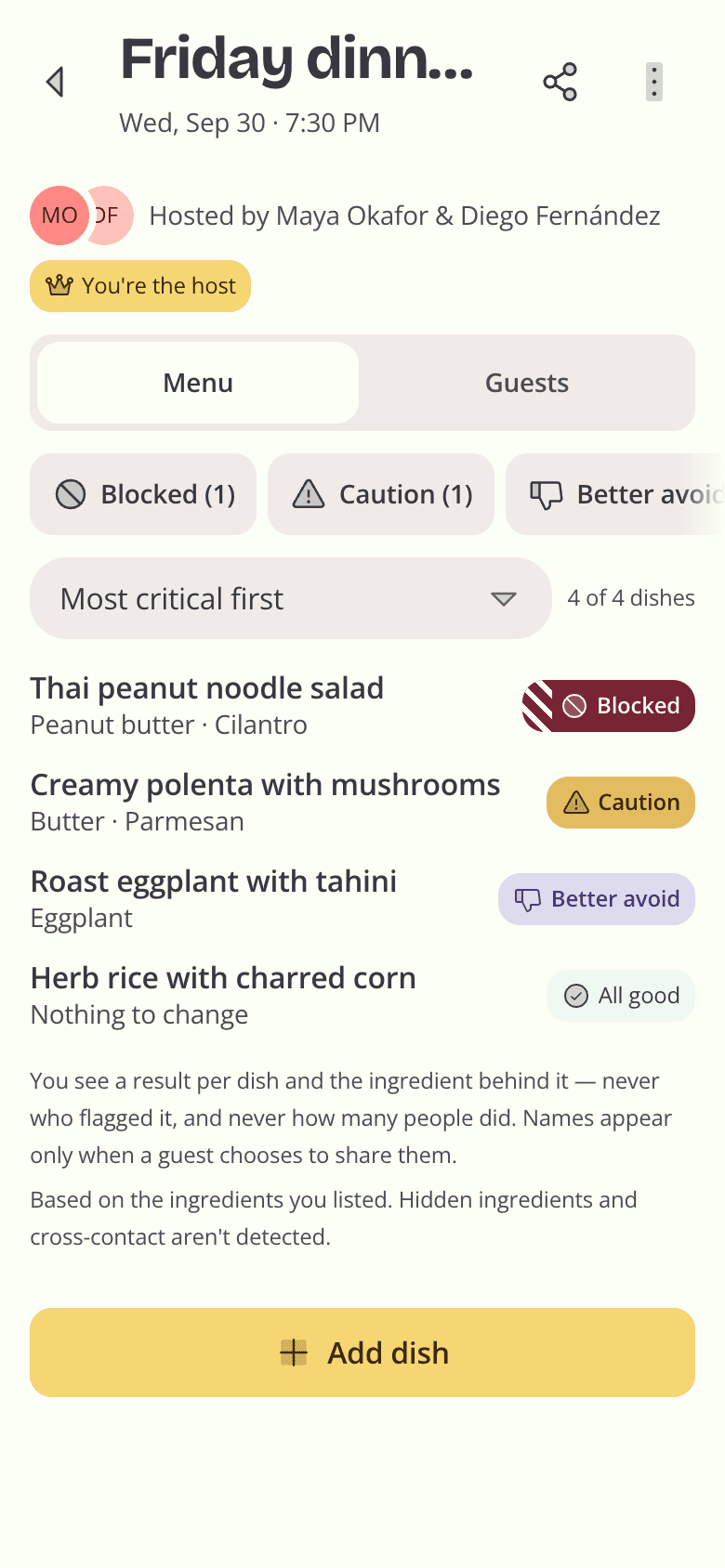
Every dish gets a status: blocked, warning, worth avoiding, or fine. Per dish — never per person.
Three different things.
Allergies, intolerances and ARFID often get treated as one. They are not, and each asks something different of the person cooking.
Food allergy
The immune system overreacting to a food. It is often mild, but for some people it can be very serious, and symptoms can start straight after eating or days later.
What counts as a major allergen depends on where you live: the US names 9, the UK and EU name 14. A guest cannot assume the person cooking is checking for theirs.
In Picky Eaters, an allergy blocks a dish.
Sources: NHS: Food allergy · FDA: Food allergies · FSA: Allergen guidance
Food intolerance
Difficulty digesting a food or an ingredient in it. Lactose is the most common one, but it can be many things, from some additives to caffeine.
It is not the immune system, so it cannot cause a serious allergic reaction. It is not usually serious, but it can leave someone unwell for hours or days. Coeliac disease is different: it is an autoimmune condition, and gluten has to be avoided completely.
In Picky Eaters, an intolerance warns about a dish.
Source: NHS: Food intolerance
ARFID
Avoidant/restrictive food intake disorder: avoiding certain foods, eating a restricted amount, or both. It can come from sensitivity to taste, texture or smell, from fear after an experience like choking, or from low interest in eating, often more than one at once.
It affects children, teenagers and adults, at any weight, and it is not about body shape. One of the signs Beat lists is trying to avoid social events where food will be present.
In Picky Eaters, ARFID informs the host. It never blocks.
Sources: Beat: ARFID · NEDA: ARFID (archived)


General information summarised from the sources linked above, not medical advice.
Severity is not taste.
Seven levels in three families. Medical levels block or warn. Preferences suggest. ARFID informs — it never blocks.
Medical
- Allergy
- Intolerance
Allergy always carries an icon and a hatch pattern as well as its colour, so it is never colour alone.
Preference
- Favorite
- Like
- Dislike
- Hate
Preferences suggest avoiding a dish. They never block one.
Neutral
- ARFID
ARFID is information, not a warning. It sits in the quietest tier on purpose.


The host sees the dish, not the person.
Four rules the app applies to every event, whoever is hosting.
Aggregated per dish
A host sees a status per dish. No names, no counts, no lists.
Medical shows immediately
Allergies and intolerances are visible from the first guest who accepts. Safety outranks anonymity.
Preferences wait for three
Dislikes, hates and ARFID only appear once at least three guests have accepted, so an aggregate can't be traced back to one person.
Nothing else leaves your list
Notes and everything else stay with you unless you choose to share them.


Who it is for
People with food allergies
who would rather not open the evening with a risk assessment.
People with intolerances
whose reaction is real even when it is not an emergency.
People with ARFID
for whom a shared meal is a sensory negotiation, not a preference.
Hosts
who want to cook once and get it right.